In the last three years, public sector banks have responded to the RBI's policy rates more strongly than private banks.

Goyal said India has been recognised as brightest spot in the world in last five years.
At least a 25 basis points hike can be expected on the October 5 policy
However, RBI would continue to nudge banks to cut lending rates

Leading economists have pencilled in a high 13-15.7 per cent uptick in the economy in the first quarter of 2022-23 with an upward bias. Soumya Kanti Ghosh, the group chief economic adviser at State Bank of India, on Tuesday said he expects the GDP to clip past 15.7 per cent in the first quarter with more chances of the final numbers printing in higher, while Aditi Nayar, the chief economist at the rating agency Icra, said the economy will grow much lower at 13 per cent in the June quarter. The national statistical office will announce the first quarter GDP numbers later next week.

Retail inflation declined to a three-month low of 5.1 per cent in January, mainly due to subdued prices of vegetables, fruits and other food items, according to government data released on Monday. The fall indicates that retail inflation is inching towards the Reserve Bank's comfort level of 4 per cent. The Consumer Price Index (CPI) based inflation was on the rise for two straight months after touching a trough of 4.9 per cent in October 2023. In December, it stood at 5.69 per cent.
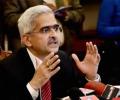
Amid prolonged uncertainty, continued policy support will be crucial for sustained economic recovery from the coronavirus pandemic, Reserve Bank Governor Shaktikanta Das said at the recent meeting of the Monetary Policy Committee. "In this period of prolonged uncertainty, it would be wise to remain agile and respond in a gradual, calibrated and well telegraphed manner to the emerging challenges," opined Das, according to the minutes of the MPC meeting released by the Reserve Bank on Thursday. Observing that economic recovery from the pandemic remains incomplete and uneven, he said, "continued support from various policies remains crucial for a sustained recovery." The governor said the renewed surge in international crude oil prices, however, requires close monitoring.
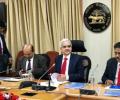
The fourth consecutive rate cut is expected to lower equated monthly instalments (EMIs) for home and auto buyers, and borrowing cost for corporate.
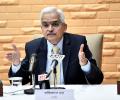
The Reserve Bank of India (RBI) on Wednesday raised the benchmark lending rate by 35 basis points to 6.25 per cent in a bid to tame inflation, which has remained above its tolerance level for the past 11 months. With the latest hike, the repo rate or the short-term lending rate at which banks borrow from the central bank now has crossed 6 per cent. This is the fifth consecutive rate hike after a 40 basis points increase in May and 50 basis points hike each in June, August and September.
With retail inflation surprising on the upside, the six-member monetary policy committee (MPC) of the Reserve Bank of India (RBI) is expected to increase the repo rate by 35-50 basis points (bps) in the review scheduled for September 28-30. According to economists, the central bank will continue to focus on bringing inflation down even though economic growth has remained sluggish. Data released by the government on Monday showed that the consumer price index (CPI)-based inflation increased by 7 per cent year-on-year (YoY) in August, thus, staying above the upper tolerance limit of the central bank for all the eight months of 2022.

Fitch Solutions sees RBI keeping benchmark interest rates unchanged during the fiscal to March 2022 following its decision to buy Rs 1 lakh crore of government bonds. "We had initially expected another policy rate cut to arrest the rise in government bond yields since the Union Budget announcement in February. "However, having an explicit bond purchase guidance from the RBI following the announcement of the G-SAP will also achieve a similar effect, if not even be more effective than a rate cut on capping the increase in bond yields," it said in a note. The Reserve Bank of India (RBI) held its policy repurchase (repo) rate unchanged at 4 per cent at its monetary policy meeting on April 7.

Finance Minister Nirmala Sitharaman is scheduled to address the post-budget meeting of the RBI's central board on Monday and highlight key points of the Union Budget 2022-23, including the fiscal consolidation roadmap and high capex plan. It has been a custom that the finance minister addresses the RBI board, consisting of RBI Governor and existing four deputy governors, after the Budget. The meeting has been scheduled for February 14 where she would be addressing the board members and talk about announcements made in the Budget to perk up growth hit by three waves of COVID-19, sources said.
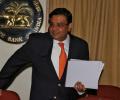
Fitch said the full implications of Patel's resignation will only become clearer once there is some indication of the RBI's policy approach under his replacement, Shaktikanta Das
The Reserve Bank of India's rate-setting panel will go for a 0.35 per cent hike in the key repo rate at its meeting next week, an American brokerage said on Wednesday. The hike will be accompanied by a change in the policy stance to "calibrated tightening", Bofa Securities said in a report published ahead of the Monetary Policy Committee (MPC) resolution which is set to be announced on August 5. RBI has hiked the rate by a cumulative 0.90 per cent in two tightening moves in May and June, responding to the runaway headline inflation which has consistently overshot the upper end of the target set for the central bank for many months.
'Overall, domestic demand has moderated significantly. 'The weakening of private consumption, which for long has been the bedrock of aggregate demand, in particular, is a matter of concern,' RBI Governor Shaktikanta Das said in the MPC meetings, in October.
The Reserve Bank of India on Friday decided to leave benchmark interest rate unchanged at 4 per cent but maintained an accommodative stance as the economy faces heat of the second Covid wave.

RBI Governor Shaktikanta Das said that early containment of the pandemic could impart an "upside" to the economic growth outlook.

'We have delivered a bitter medicine. It will take time to work.'
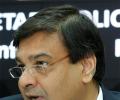
Chetan Ghate, Pami Dua and Ravindra Dholakia have been appointed for 4 years

While the economy seems to be on a firm growth path, the fight against inflation is not over yet. Shaktikanta Das seems to be in no hurry. After playing well through a five-year Test match, he doesn't want to get out hit wicket, observes Tamal Bandyopadhyay.

Gaurav Garg, head of research at CapitalVia Global Research Limited will answer your stock market queries.

The government had amended the RBI Act through Finance Act 2016.

Voting for the 2014 general elections will begin in April and it is expected Budget 2014-15 will be presented in June.

The man widely expected to be India's next central bank chief favours clipping the autocratic power of the role and giving more say to a monetary policy committee.

The decision to permit the third child came after this month's once-in-a-decade census showed that China's population grew at the slowest pace to 1.412 billion amid official projections that the decline may begin as early as next year.

All sectoral indices ended lower. BSE Telecommunication tanked 2.18 per cent, metal (1.77 per cent), auto (1.70 per cent), energy (1.64 per cent), oil & gas (1.59 per cent), commodities (1.39 per cent) and financial services (1.37 per cent) were the major laggards.
The Reserve Bank of India on Friday decided to keep the benchmark interest rate unchanged at 4 per cent but maintained an accommodative stance as the economy is yet to recover from the impact of the second Covid wave.

RBI governor is seen succeeding International Monetary Fund (IMF) chief executive officer, Christine Lagarde, next year.

Observing that there is liquidity overhand of Rs 13 lakh crore in the system, RBI Governor Shaktikanta Das said on Friday that the exceptional measures undertaken during pandemic will be dealt in sync with macroeconomic developments to preserve financial stability. Since the onset of the pandemic, the Reserve Bank has maintained ample surplus liquidity to support a speedy and durable economic recovery, he said while announcing the outcome of the Monetary Policy Committee (MPC) meeting. The level of surplus liquidity in the banking system increased further during September 2021, with absorption under fixed rate reverse repo, variable rate reverse repo (VRRR) of 14 days and fine-tuning operations under the liquidity adjustment facility (LAF) averaging Rs 9 lakh crore per day as against Rs 7 lakh crore during June to August 2021, he said.

Vijay, despite the loud message from his delayed arrival at the road-show/stampede venue, and more so his continued inaccessibility for fans-turned-cadres after graduating from a super-star to a political party leader with electoral ambitions, refuses to change. Or, so it seems, observes N Sathiya Moorthy.

The RBI has doubled the limit of maximum balance that an individual customer can hold with payments banks to Rs 2 lakh from Rs 1 lakh earlier with immediate effect to expand the ability of such lenders to cater to the needs of MSMEs and other businesses.

India's manufacturing sector activity hit the highest level in eight months in July, driven by a significant rise in business orders, a monthly survey said on Monday. The seasonally adjusted S&P Global India Manufacturing Purchasing Managers' Index rose from 53.9 in June to 56.4 in July, reflecting the strongest improvement in the health of the sector in eight months. The July PMI data pointed to an improvement in overall operating conditions for the 13th straight month.
The wholesale price-based inflation eased to a 29-month low of 1.34 per cent in March on easing prices of manufactured products and fuel items, even though food articles turned expensive.

In its Fifth Bi-monthly Monetary Policy Statement, 2017-18, RBI said the second quarter growth was lower than the one that was projected in the October review, and the recent increase in oil prices may have a negative impact on margins of firms and Gross Value Added (GVA) growth.

Rupee ends flat against dollar ahead of Fed policy outcome.

The services sector growth in India rose to a 13-year high in September on sharp increase in new business amid strong demand conditions, and job numbers continued to increase as overall business mood improved, a monthly survey said on Thursday. The seasonally adjusted S&P Global India Services PMI Business Activity Index rose from 60.1 in August to 61 in September, signalling a sharp upturn in output. In Purchasing Managers' Index (PMI) parlance, a print above 50 means expansion while a score below 50 denotes contraction.

Although there is headroom for further monetary policy action, at this juncture it is important to keep our arsenal dry and use it judiciously: RBI's Das.
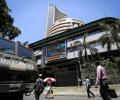
Bank Nifty pared all its intraday gains to end over 1% lower led by losses in BoB, ICICI Bank, Axis Bank and Bank of India

The RBI on Friday said the impact of coronavirus outbreak on the economy will depend on the intensity, spread and duration of the deadly virus even as the central bank refrained from projecting any numbers for growth and inflation amid the widespread uncertainty. While announcing the seventh bi-monthly monetary policy statement for 2019-20, RBI Governor Shaktikanta Das said that in view of the impact of coronavirus pandemic, the growth projections for 4.7 per cent for the fourth quarter of 2019-20 and 5 per cent for the full fiscal are "now at risk".

Acharya was one of the youngest deputy governors in the central bank's history and was in charge of the critical monetary policy department which also made him a part of the rate-setting panel.
